

Le Mans Liveries by Decade: A Fan Style Guide
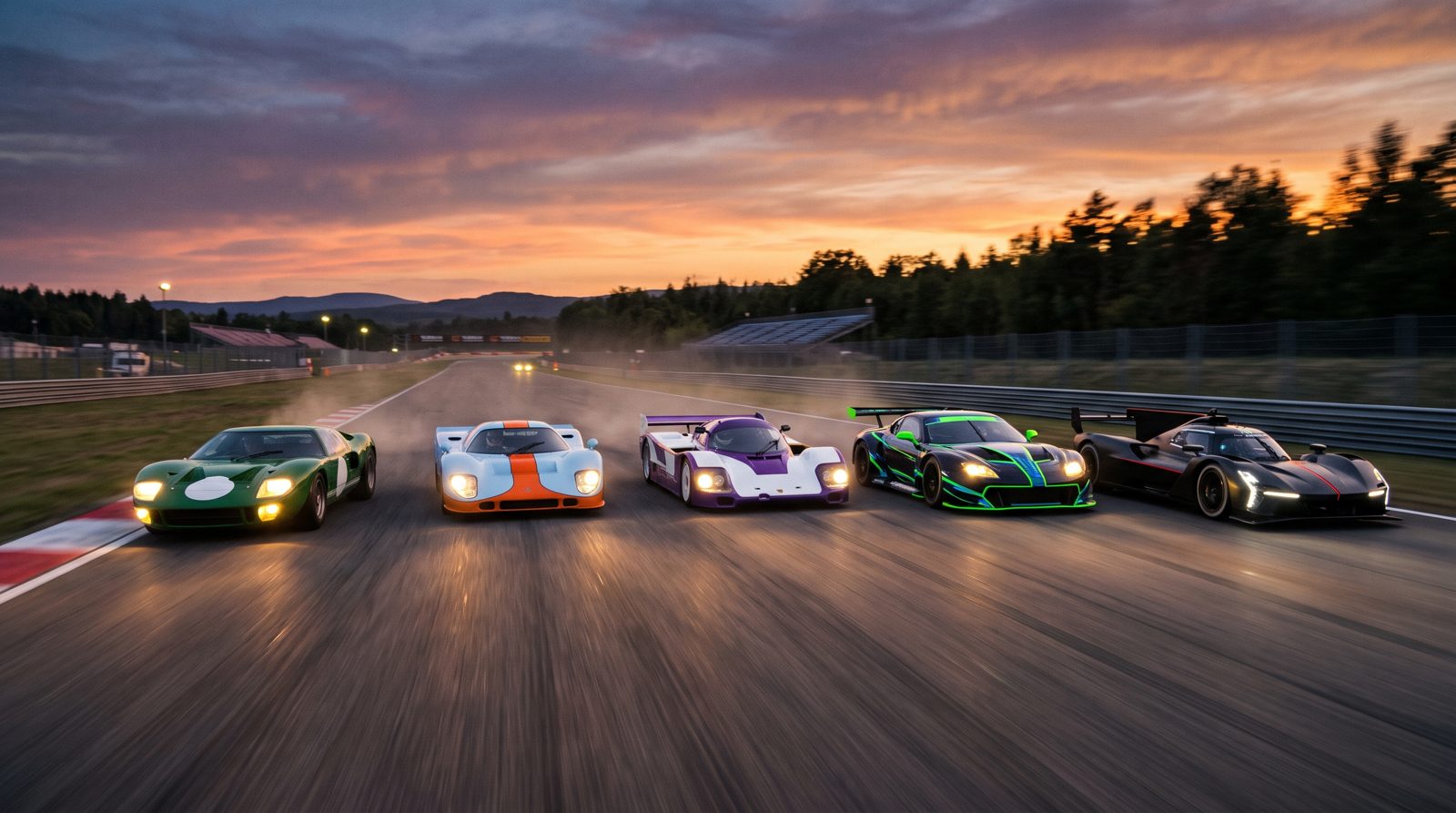
The 24 Hours of Le Mans has run since 1923, and for most of that century the cars have doubled as moving posters. A livery tells you the era before you read the entry list: national racing colours in the 1950s, bold sponsor stripes in the 1970s, long Group C prototypes in the 1980s, dark carbon and neon in the hybrid years. This guide walks through each decade, explains what defined its look, and shows how to wear that style as fan apparel.
Quick answer: pick one era, match one or two accent colours to a neutral base, and choose the garment for the weather at your event. A polo suits a warm June weekend at La Sarthe, while a quarter-zip or bomber covers the cold hours after midnight.
Why Le Mans liveries matter to fans
Endurance racing is long, so fans remember the cars rather than single moments. A team's colours run for 24 hours, through dusk, night and dawn, under floodlights and in rain. That is why certain colour combinations stay recognisable decades later, and why endurance fans often know a car by its paint scheme before its chassis name.
1920s to 1960s: national racing colours
Before commercial sponsorship, cars raced in colours that represented their country:
- Green for Britain, the origin of the phrase "British racing green".
- Red for Italy.
- Blue for France.
- White, later silver, for Germany.
Liveries were simple: one body colour, a white roundel for the race number, and perhaps a stripe. For apparel, this era translates into clean, minimal designs. A solid polo with a contrast collar and a single number roundel looks period-correct and works away from the track too.
1970s: sponsors arrive and the stripes get bold
Commercial sponsorship arrived in the late 1960s and changed racing design for good. Teams painted cars in their backers' colours, and the 1970s became the decade most fans picture when they think of classic endurance racing.
The most copied scheme of the period is the light blue and orange of the endurance cars that raced in 1970 and 1971, made even more famous by a 1971 Le Mans film. Its pale base, wide central stripe and large race number still appear on fan clothing today.
Other features of the decade: long-tail bodywork, wide stripes running nose to tail, and big sponsor-style panels on the sides. On apparel, look for a strong vertical stripe down the front, a large number on the chest, and colour panels on the sleeves.
Browse Gulf Le Mans inspired designs or the wider Le Mans collection.
1980s: Group C and the big-sponsor era
Group C rules from 1982 created low, wide prototypes with enclosed cockpits and huge flat surfaces, which gave sponsors more space than ever. Liveries became bolder and more graphic:
- Dark bases with bright accent lines.
- Purple, white and gold schemes, including the colours of the 1988 winner.
- White cars with blue and red bands from the period's best-known teams.
Group C designs suit quarter-zips and jackets, where the stripes can wrap from the chest around to the back the way they wrapped around the bodywork.
1990s: GT1 and the manufacturer comeback
When Group C ended in the early 1990s, road-based GT cars returned to fight for overall wins. Manufacturers came back with factory teams, and liveries grew brighter and busier: darker bases, neon accents, graphic swooshes and more sponsor logos per square metre. If you like a louder design, this is your decade.
2000s and 2010s: prototypes, diesels and hybrids
Closed prototypes, diesel engines and then hybrid systems brought a more technical look. Liveries used angular shapes, carbon-black areas and a single strong brand colour. Many fans like this era for smart-casual wear because the palettes are restrained: black, silver and one accent.
2020s: the hypercar era
The Hypercar class brought manufacturers back to the top category in large numbers. Today's liveries mix heritage references with modern graphics, and many teams run special one-off schemes at Le Mans. See endurance racing (WEC) inspired apparel for modern designs.
How to wear each era
| Era | Look | Best garment | Pair with |
|---|---|---|---|
| 1950s to 1960s | Single colour, number roundel | Polo shirt | Chinos, white sneakers |
| 1970s | Pale base, wide stripe, big number | Polo or quarter-zip | Jeans, a plain cap |
| 1980s | Dark base, bold sponsor bands | Quarter-zip or bomber jacket | Black trousers |
| 1990s | Bright, graphic, neon accents | Jersey or hoodie | Neutral basics |
| 2010s to today | Carbon black, one accent colour | Polo or quarter-zip | Smart casual |
Three simple rules:
- One era per outfit. A 1970s polo with a 1990s cap looks mismatched.
- Let the shirt carry the colour. Keep trousers and shoes neutral. A racing cap in one matching accent colour is enough.
- Dress for the night. Le Mans weather turns cold after sunset. Bring a quarter-zip jersey or bomber jacket.
Make it yours
Many of our Le Mans designs let you replace the race number, the name and even the year with your own. Use the year of your first visit to La Sarthe, or the number you run at track days. See how to personalise a racing shirt for the full guide.
Planning for the next race
Every item is made to order. Production plus delivery to the UK, EU and US usually takes 12 to 15 business days, so order at least three weeks before a race weekend. Orders over $100 ship free worldwide, and multi-buy discounts of 10%, 15% and 20% apply automatically on 2, 3 and 4 or more items, useful for group trips.
FAQs
What is the most famous Le Mans livery?
Fans most often name the light blue and orange scheme from the early 1970s, because of its race wins and its appearance in a 1971 film about the race. Group C schemes from the 1980s come a close second.
What should I wear to the 24 Hours of Le Mans?
Layers. A breathable polo for the afternoon, a quarter-zip or jacket for the night, comfortable shoes for walking between grandstands, and a cap for the sun.
Are these official Le Mans products?
No. Kozmozcyber designs are independent fan artwork inspired by endurance racing history. We are not affiliated with the ACO, the 24 Hours of Le Mans, any manufacturer or team.
How long does delivery take?
Each item is made to order. Production plus delivery usually takes 12 to 15 business days.
Circuit de la Sarthe Engineering: How Aerodynamics, Night Stints, and Mechanical Stamina Define Endurance Liveries
Unlike ninety-minute Grand Prix sprints run on billiard-smooth permanent autodrome asphalt, the 13.626-kilometer Circuit de la Sarthe mixes permanent track sectors with crowned public highway lanes from Mulsanne to Arnage. Cars spend over seventy percent of every lap at full throttle, reaching top speeds above 330 to 345 km/h before braking hard into the Daytona and Michelin chicanes or threading through the high-speed Porsche Curves. That punishing duty cycle shapes every curve of the bodywork and every paint scheme featured in Le Mans Liveries by Decade: A Fan Style Guide.
In endurance prototype and GT racing, a livery is far more than a sponsor billboard. Spotters perched on the pit wall at 3:00 AM, marshals stationed at Indianapolis, and mechanics preparing tires in the garage rely on high-contrast nose stripes, fin numbers, and roof-mounted leader lights to identify sister entries through rain spray and headlight glare. Whether a team runs classic powder blue and marigold orange, royal purple and white, or Rosso Le Mans scarlet paired with Giallo Modena yellow, high-visibility color blocking separates factory cars from customer entries at a single glance.
Night stints also expose every weakness in chassis balance and driver ergonomics. As track temperatures drop by fifteen degrees Celsius between sunset and dawn, aerodynamic downforce efficiency shifts, brake duct blanking must be adjusted during fuel stops, and triple-stinting medium-compound Michelin tires becomes the decisive strategic weapon. Understanding these mechanical details explains why endurance fans form such deep emotional bonds with specific chassis numbers and race-winning colorways.
Collector & Enthusiast Reference Matrix: Era Specifications vs. Tribute Apparel Design
To help enthusiasts connect the historical details of Le Mans Liveries by Decade: A Fan Style Guide with authentic trackside wardrobe choices, our comparison table outlines the defining technical characteristics of classic motorsport eras alongside the construction standards used in our custom fan-inspired tribute garments:
| Dimension | Historic Track & Livery Benchmark | Modern Broadcast & Paddock Standard | Kozmozcyber Custom Tribute Execution |
|---|---|---|---|
| Colorway & Contrast | High-contrast analog paint schemes engineered for naked-eye pit wall visibility | Matte carbon-weight-saving finishes with neon LED number panels | 200°C HD dye-sublimation locking deep, fade-proof pigments into the yarn |
| Material & Breathability | Heavy quilted cotton and early multi-layer flame-retardant race overalls | Lightweight moisture-wicking paddock team polos and softshell outer layers | 230 GSM 95% poly / 5% spandex micro-pique polos & 250 GSM brushed fleece hoodies |
| Graphic Durability | Embroidered cloth patches and hand-painted chassis roundels | Heat-transfer vinyl logos that often crack after repeated machine washing | Panel-by-panel cut-and-sew printing with zero surface film, cracking, or peeling |
| Personalisation | Driver surname and blood-group stitching on the belt or upper chest | Fixed driver numbers #1 to #99 assigned by championship regulations | Custom name, car number, or sim-racing team title dyed directly into chest and back |
How to Build a Trackside & Watch-Party Wardrobe Inspired by Motorsport History
Whether you are walking the support-race paddock at Silverstone, camping near Arnage during the 24 Hours of Le Mans, or hosting a Sunday morning Grand Prix watch party, dressing for a race weekend requires balancing visual heritage with all-day climate comfort. Trackside temperatures can swing from 32°C asphalt glare during afternoon qualifying to chilly 10°C gusts once the sun drops behind the grandstands.
Start with a breathable 230 GSM all-over print racing polo shirt from our Grand Prix Era collection or 24 Hours of Le Mans collection as your base layer. Unlike stiff plastisol screen prints that trap sweat against your chest, dye-sublimated micro-pique allows full airflow right through the deepest black, scarlet, or royal purple panels. For cooler evening sessions or autumn rounds at Spa-Francorchamps and Suzuka, layer a sherpa-lined quarter-zip pullover or a wind-resistant motorsport bomber jacket over your polo.
If you are ordering gear for a karting club, sim-racing league, or family race trip, remember that combining 2, 3, 4, or 4+ garments in a single cart automatically unlocks 5% to 20% multi-buy bundle savings, and orders over $100 qualify for free tracked standard shipping worldwide.
Frequently Asked Questions About Motorsport Heritage & Custom Tribute Gear
Why do historic motorsport liveries remain so popular in modern streetwear?
Classic liveries from the 1960s through the 1990s were designed for instant visual recognition without digital graphics, using bold color theory, clean racing stripes, and iconic number roundels that translate naturally into timeless polos, jackets, and quarter-zip pullovers.
How does dye-sublimation keep vintage racing colors from fading in the wash?
During cut-and-sew production, solid ink is heat-pressed at 200°C (392°F) so it turns into gas and bonds permanently inside the polyester fibers. Because the color is inside the yarn rather than sitting on top as a rubberized layer, it never cracks, peels, or washes out.
Can I add my own driver name and race number to a heritage tribute shirt?
Yes. Most shirts, hoodies, and jackets on Kozmozcyber.store include optional personalisation fields ($1.45 to $2.50) so you can print your own name, lucky race number, or karting team name directly into the garment panels before sewing.
What sizes are available for custom motorsport tribute apparel?
Our cut-and-sew polos, quarter-zip jerseys, hoodies, and bomber jackets are available in Kids, Youth, and Adult sizes from S up to 5XL with a relaxed athletic fit. Check our size measurement guide before ordering.
Are the garments featured with this article official team or championship merchandise?
No. All team, driver, car, and circuit names in our editorial articles are used strictly for historical and journalistic commentary. Apparel sold on Kozmozcyber.store consists of independent, fan-inspired tribute artwork and is not affiliated with or endorsed by any racing team, driver, or championship.
SHARE


0 comment
Be the first to comment